
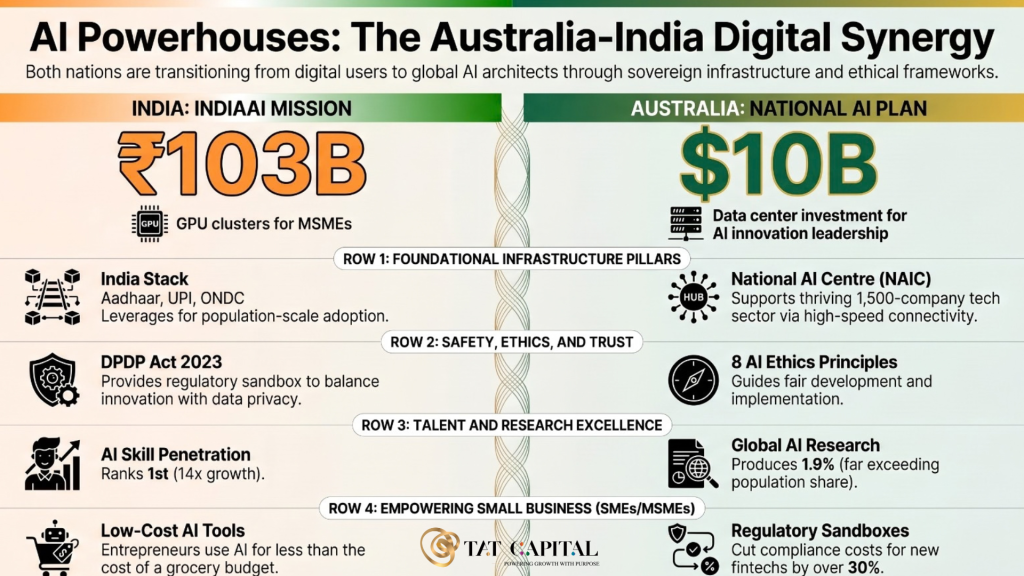
Australia and India have each solved the half of the small-business AI problem the other finds hardest.
Every conversation I have about AI in the Australia–India corridor ends up at the same point. The technology is not what’s holding firms back. Adoption is. The gap is widest among the firms that matter most to both economies: small and medium businesses.
I’ve spent the past few weeks putting together a blueprint on this, drawing on government data, industry research and policy papers from both countries. Here’s what I found.
The gap is real on both sides
Small firms are the backbone of both economies. Australia has 2.74 million small businesses, 97% of all trading businesses, producing about a third of GDP. India has 74.7 million MSMEs, about 27 times as many, producing 31% of GDP and nearly half of exports.
Both are under-using AI. About 43% of Australian SMEs report any AI use at all. Indian MSME estimates are lower; the figure often cited is around 19%. The upside is large. A July 2026 Google and India SME Forum study estimates AI could unlock over US$490 billion for Indian MSMEs.
What struck me most is that the barriers are almost identical. In Australia, 65% of non-adopters say they don’t trust AI decisions or want to keep human control. In India, the barriers are capital, talent and the difficulty of integrating with legacy systems. The details differ, but in both countries owners are asking whether they can trust it, afford it and make it work.
Two models, one goal
This is where the story gets interesting. The two countries have attacked the problem from opposite ends.
India built shared public rails first, at population scale:
- Aadhaar for identity
- UPI for payments: 24.5 billion transactions in August 2026 alone
- Account Aggregator for consented data sharing
- ONDC for open commerce
- IndiaAI subsidised compute: 38,000+ GPUs at about ₹65 an hour
It is now layering AI on top of those rails, an idea the source papers call Digital Public Intelligence, or DPIQ. A small manufacturer doesn’t build intelligence. It rents it.
Australia has taken a guided, trust-first route: four AI Adopt Centres giving SMEs free specialist advice, a new AI Safety Institute, and the 8 AI Ethics Principles. It also has its own rails, which are newer and less well known: Digital ID, the New Payments Platform and the Consumer Data Right.
Put simply, India’s model makes AI cheap and easy to try. Australia’s makes it safe and credible to trust. Each country is strong exactly where the other is thin.
The convergence nobody is talking about
By late 2025, both governments had independently landed on the same regulatory posture. Australia’s National AI Plan and India’s AI Governance Guidelines both rely on principles and existing law rather than a new AI statute.
That matters a great deal. It means the two countries could mutually recognise AI testing and assurance without either one rewriting its laws. It is the single biggest enabler of cooperation, and it is available now.
The plumbing already exists
The institutional links are in place:
- The Comprehensive Strategic Partnership
- The Cyber and Critical Technology Partnership, with 19 joint projects so far
- ECTA, with CECA under negotiation
- The CSIRO–Atal Innovation Mission RISE Accelerator
- As of July 2026, the new PACTS framework on cyber, critical technologies and supply chains
What’s missing is a program that connects all of this to the small firm in Bengaluru or the Riverina.
The capital case
Capital is already moving. Australian investment in India reached A$26.8 billion at the end of 2025, and Indian investment in Australia A$45.3 billion. AustralianSuper’s A$500 million follow-on commitment to India’s National Investment and Infrastructure Fund in July took its India exposure to A$3.3 billion.
Where I see the real opportunity for Australian investors is in the credit loop. In India, consented data from Account Aggregator feeds AI credit scoring, which unlocks cash-flow lending for firms with no collateral. MSMEs face a credit gap of about ₹20 lakh crore. That is emerging-market yield with a measurable development impact, built on public infrastructure that is already working.
Other openings:
- Australian domain AI in agriculture, health and mining, deployed at Indian scale
- Trusted Australian hosting for Indian SaaS firms
- Cross-border payment links for SMEs and the million-strong Indian diaspora
What I’m proposing
An Australia–India SME AI Corridor, run under PACTS and written into CECA, in three phases:
1. Foundations (2026–27): a common SME AI adoption index, and a joint RISE-style adoption cohort in agriculture, health and logistics.
2. Interoperability (2028–29): links between the Consumer Data Right, Digital ID and India’s consented-data rails, a UPI–NPP payments link, and mutual recognition of AI assurance.
3. Scale (2030): a co-investment facility for DPI-enabled MSME lending, and a shared reference architecture to offer the wider Indo-Pacific.
For business, the advice is simpler:
- Treat India’s DPI as a distribution channel, not a competitor.
- Export specialist AI, not generic AI.
- Put people who know the other market on your board.
The Perth USAsia Centre’s research on Australian firms in India says it plainly: firms that failed usually didn’t commit enough, not because the market was wrong.
The bottom line
Australia brings trust, capital, standards and trusted hosting. India brings interoperable infrastructure, engineering scale and a market of 74.7 million small firms. Together they make an end-to-end AI supply chain that neither can build alone at comparable cost.